Trigger depth is the accumulation that starts a service visit, and it is the term in a snow contract with the largest effect on both your cost and your risk. Most properties accept whatever number the contractor proposes without asking how it was chosen. This guide covers how to pick the right depth for your site, how it should be measured, and the mistakes that make the number meaningless in practice.
What is snow trigger depth?
Trigger depth is the accumulation, stated in centimetres, at which the contractor is obliged to attend and clear. Below it, no visit is required. At or above it, the response clock starts.
It is the mechanism that converts a snowfall into a contractual obligation. Without it, a contract has no defined moment at which the contractor must act, which means there is nothing to hold them to and nothing for you to point at afterward.
A property can have more than one trigger, and most should. The lot, the walkways, and the salting programme are three different jobs with three different risk profiles.
How does trigger depth affect cost and risk?
The relationship runs in opposite directions, and choosing the number means deciding where to sit between them.
A lower trigger produces more visits. Costs rise, surfaces stay in better condition, and less snow gets compacted into ice by traffic. A higher trigger produces fewer visits, lower cost, and more accumulation between services, which means more compaction and more ice.
The risk side is not proportional to the cost side. Going from a high trigger to a moderate one removes a large amount of risk for a modest increase in cost. Going from moderate to very low costs considerably more and removes comparatively little additional risk. The useful range for most commercial properties sits in the middle, and the argument is usually about where in the middle.
What should your trigger depth be?
Set it against how the property is used, not against a default number.
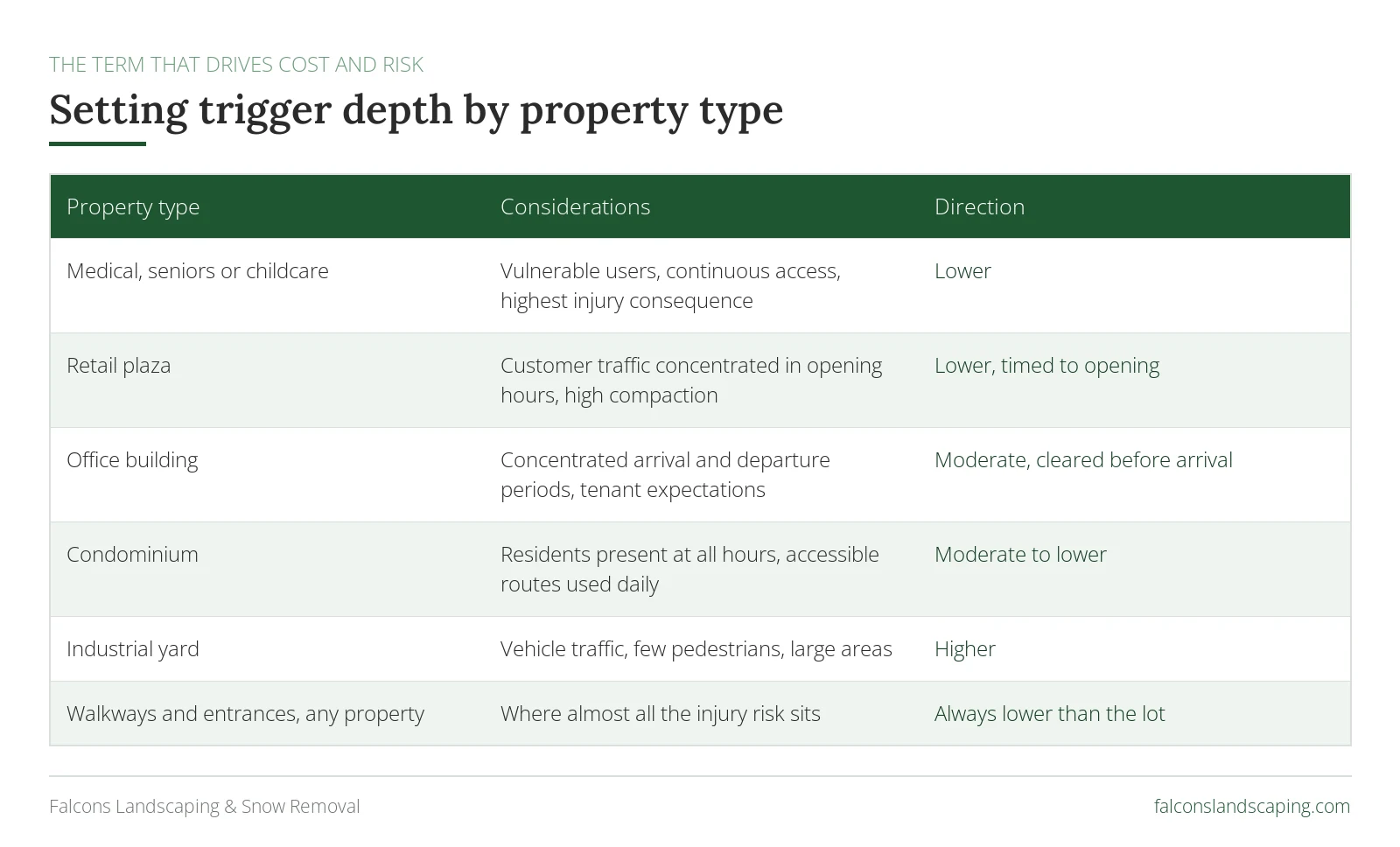
The walkways row is the recommendation worth acting on regardless of property type. Applying one trigger across the whole site means pedestrian surfaces wait for the same accumulation as the parking area, which puts the slowest response where the highest risk is. Splitting the trigger costs relatively little because walkway areas are small.
Where is the depth actually measured?
This is the question almost nobody asks, and it decides whether the number means anything. Snow does not fall evenly across a commercial property. Wind moves it, buildings shelter parts of the lot, and drifting can leave one corner at twice the depth of another.
Settle four points in the contract:
The measurement location. A defined open point on the property, marked on the site plan, rather than "on site" generally.
Who measures. The contractor on arrival, a fixed gauge, or a named weather station.
What happens with drifting. Whether drifted areas are serviced even when the measured point is below trigger.
The record. That measured accumulation is entered on the service log for every visit and every decision not to attend.
That fourth point turns the trigger from a promise into something you can audit. A log recording "attended, 6 cm measured" and another recording "checked, 2 cm, below trigger" gives you a continuous account of the property. Logs that record only visits leave the non-visit days unexplained, and those are the days a claim is most likely to concern.
What about ice with no snowfall?
A snow trigger does nothing for ice, and this is the largest gap in most commercial contracts. Freezing rain, meltwater refreezing overnight, and freeze thaw cycles all create hazardous surfaces without producing any measurable accumulation.
Your contract needs a separate salting trigger written in conditions rather than depth. Something along the lines of ice formation, freezing rain, or surface temperature at or below zero with moisture present. Whatever the wording, it must be capable of triggering on a day when the snow gauge reads zero.
Ask specifically how the contractor identifies those days. A dispatch model driven only by accumulation will miss them, and they generate a disproportionate share of winter incidents. For more on the materials themselves, see our guide to choosing an ice melter that is safe for concrete.
What are the common mistakes?
Five recur across commercial contracts in the GTA.
One trigger for the whole property. Walkways wait as long as the lot.
No measurement location. The number is unenforceable because nobody agreed where it applies.
No salt trigger. Ice days generate no obligation at all.
No rule for continuous events. A long storm accumulates well past the trigger before anyone attends.
No record of non-visits. Days below trigger leave a gap in the account of the property.
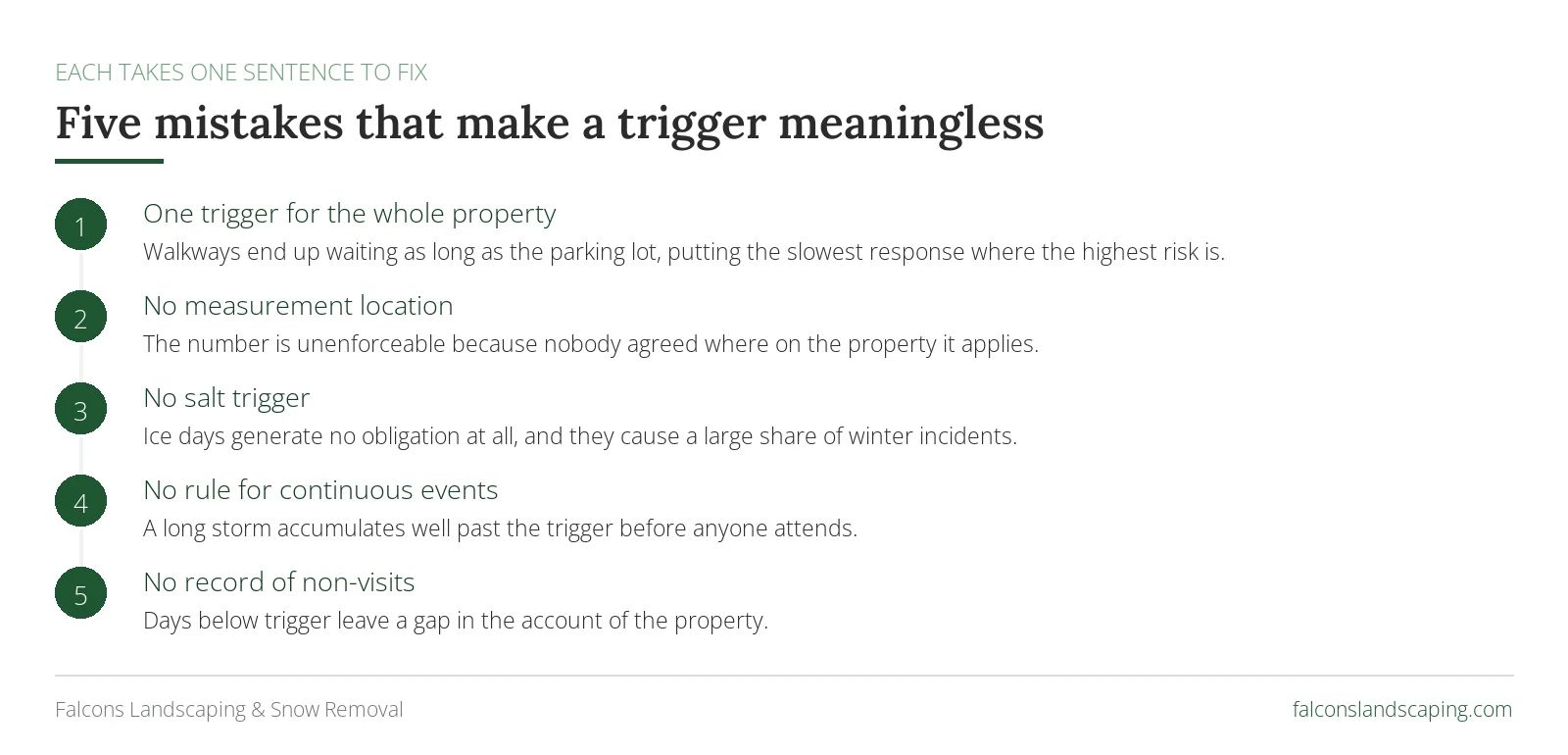
Each one takes a sentence to fix at contract stage and is close to impossible to fix in January.
Falcons Landscaping sets separate lot and pedestrian triggers, marks the measurement location on the site plan, and logs measured accumulation on every visit across Mississauga, Oakville, and Burlington. To review the triggers on your current agreement, request a quote or read more about commercial snow removal.
Frequently asked questions
What is a typical snow removal trigger depth?
Commercial triggers commonly sit somewhere between 2.5 cm and 5 cm, with walkways at the lower end and large parking areas at the higher end. The right figure depends on pedestrian traffic and hours of use rather than a standard.
Should walkways have a lower trigger than the parking lot?
Yes, in almost every case. Pedestrian surfaces carry most of the injury risk, and walkway areas are small enough that a lower trigger adds relatively little cost.
Who measures the snow depth?
Whoever the contract says, which should be stated explicitly. Options include the contractor measuring on arrival at a marked point, a fixed gauge on site, or a named weather station. Vagueness here makes the trigger unenforceable.
What happens if snow drifts unevenly across the lot?
That depends on the contract. Ask for wording that requires drifted areas to be serviced even when the measured point sits below trigger, otherwise a sheltered gauge can leave a drifted entrance uncleared.
Does the trigger depth apply to salting?
It should not. Ice forms without accumulation, so salting needs its own trigger written in conditions such as freezing rain or surface temperature at or below zero with moisture present.
Trigger depth is the accumulation that starts a service visit, and it is the term in a snow contract with the largest effect on both your cost and your risk. Most properties accept whatever number the contractor proposes without asking how it was chosen. This guide covers how to pick the right depth for your site, how it should be measured, and the mistakes that make the number meaningless in practice.
What is snow trigger depth?
Trigger depth is the accumulation, stated in centimetres, at which the contractor is obliged to attend and clear. Below it, no visit is required. At or above it, the response clock starts.
It is the mechanism that converts a snowfall into a contractual obligation. Without it, a contract has no defined moment at which the contractor must act, which means there is nothing to hold them to and nothing for you to point at afterward.
A property can have more than one trigger, and most should. The lot, the walkways, and the salting programme are three different jobs with three different risk profiles.
How does trigger depth affect cost and risk?
The relationship runs in opposite directions, and choosing the number means deciding where to sit between them.
A lower trigger produces more visits. Costs rise, surfaces stay in better condition, and less snow gets compacted into ice by traffic. A higher trigger produces fewer visits, lower cost, and more accumulation between services, which means more compaction and more ice.
The risk side is not proportional to the cost side. Going from a high trigger to a moderate one removes a large amount of risk for a modest increase in cost. Going from moderate to very low costs considerably more and removes comparatively little additional risk. The useful range for most commercial properties sits in the middle, and the argument is usually about where in the middle.
What should your trigger depth be?
Set it against how the property is used, not against a default number.
The walkways row is the recommendation worth acting on regardless of property type. Applying one trigger across the whole site means pedestrian surfaces wait for the same accumulation as the parking area, which puts the slowest response where the highest risk is. Splitting the trigger costs relatively little because walkway areas are small.
Where is the depth actually measured?
This is the question almost nobody asks, and it decides whether the number means anything. Snow does not fall evenly across a commercial property. Wind moves it, buildings shelter parts of the lot, and drifting can leave one corner at twice the depth of another.
Settle four points in the contract:
The measurement location. A defined open point on the property, marked on the site plan, rather than "on site" generally.
Who measures. The contractor on arrival, a fixed gauge, or a named weather station.
What happens with drifting. Whether drifted areas are serviced even when the measured point is below trigger.
The record. That measured accumulation is entered on the service log for every visit and every decision not to attend.
That fourth point turns the trigger from a promise into something you can audit. A log recording "attended, 6 cm measured" and another recording "checked, 2 cm, below trigger" gives you a continuous account of the property. Logs that record only visits leave the non-visit days unexplained, and those are the days a claim is most likely to concern.
What about ice with no snowfall?
A snow trigger does nothing for ice, and this is the largest gap in most commercial contracts. Freezing rain, meltwater refreezing overnight, and freeze thaw cycles all create hazardous surfaces without producing any measurable accumulation.
Your contract needs a separate salting trigger written in conditions rather than depth. Something along the lines of ice formation, freezing rain, or surface temperature at or below zero with moisture present. Whatever the wording, it must be capable of triggering on a day when the snow gauge reads zero.
Ask specifically how the contractor identifies those days. A dispatch model driven only by accumulation will miss them, and they generate a disproportionate share of winter incidents. For more on the materials themselves, see our guide to choosing an ice melter that is safe for concrete.
What are the common mistakes?
Five recur across commercial contracts in the GTA.
One trigger for the whole property. Walkways wait as long as the lot.
No measurement location. The number is unenforceable because nobody agreed where it applies.
No salt trigger. Ice days generate no obligation at all.
No rule for continuous events. A long storm accumulates well past the trigger before anyone attends.
No record of non-visits. Days below trigger leave a gap in the account of the property.
Each one takes a sentence to fix at contract stage and is close to impossible to fix in January.
Falcons Landscaping sets separate lot and pedestrian triggers, marks the measurement location on the site plan, and logs measured accumulation on every visit across Mississauga, Oakville, and Burlington. To review the triggers on your current agreement, request a quote or read more about commercial snow removal.
Frequently asked questions
What is a typical snow removal trigger depth?
Commercial triggers commonly sit somewhere between 2.5 cm and 5 cm, with walkways at the lower end and large parking areas at the higher end. The right figure depends on pedestrian traffic and hours of use rather than a standard.
Should walkways have a lower trigger than the parking lot?
Yes, in almost every case. Pedestrian surfaces carry most of the injury risk, and walkway areas are small enough that a lower trigger adds relatively little cost.
Who measures the snow depth?
Whoever the contract says, which should be stated explicitly. Options include the contractor measuring on arrival at a marked point, a fixed gauge on site, or a named weather station. Vagueness here makes the trigger unenforceable.
What happens if snow drifts unevenly across the lot?
That depends on the contract. Ask for wording that requires drifted areas to be serviced even when the measured point sits below trigger, otherwise a sheltered gauge can leave a drifted entrance uncleared.
Does the trigger depth apply to salting?
It should not. Ice forms without accumulation, so salting needs its own trigger written in conditions such as freezing rain or surface temperature at or below zero with moisture present.
Residential
Residential
View All
Commercial
View All
Close
Join our newsletter list
Sign up to get the most recent blog articles in your email every week.
Share this post to the social medias
Join our newsletter list
Sign up to get the most recent blog articles in your email every week.
Share this post to the social medias
Other Blogs
Other Similar Blogs
Your go-to destination for insightful articles, tips, and inspiration on all things landscaping and outdoor living
Other Blogs
Other Similar Blogs
Your go-to destination for insightful articles, tips, and inspiration on all things landscaping and outdoor living
Other Blogs
Other Similar Blogs
Your go-to destination for insightful articles, tips, and inspiration on all things landscaping and outdoor living